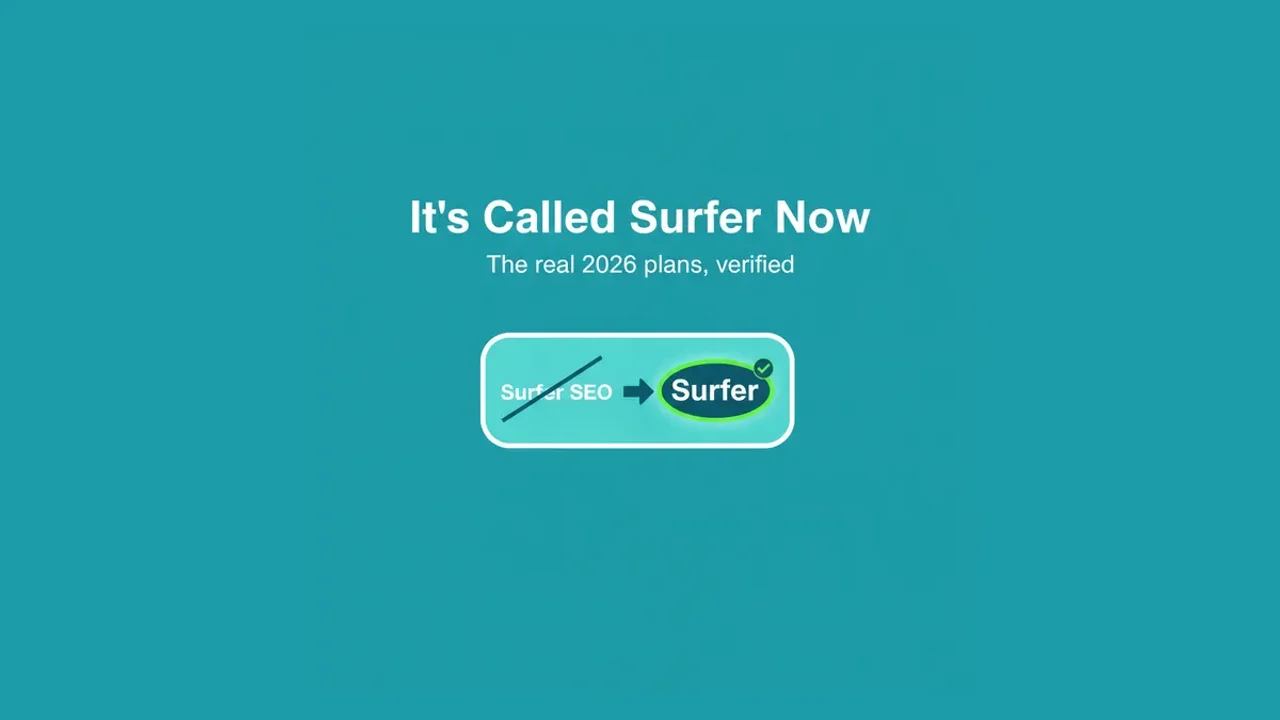
Surfer SEO isn't called that anymore, and half the reviews ranking for this keyword haven't noticed. I ran the new version against a real post of mine that was already ranking, and priced out what it costs now.
Try It Free →Surfer SEO review, 2026 edition: the tool isn't called Surfer SEO anymore. It's just Surfer now, surfer.ai, and the plan lineup changed with the name. I run a content operation producing 65,000 words a month, and I ran the current version against a post of mine that was already ranking, not a demo account, not a sandbox. Here's what's real and what's leftover marketing from the old product.
Heads up: this article contains affiliate links. If you subscribe through my links, I earn a commission, at no extra cost to you. I only recommend tools that are currently in my stack or that I've tested with real production workflows.
Surfer SEO review 2026 — the short version
Surfer rebranded from "Surfer SEO" to "Surfer" at some point in the last year, and surferseo.com now redirects straight to surfer.ai. The plans changed shape too: Discovery at $49/mo, Standard at $99/mo, Pro at $182/mo, Peace of Mind at $299/mo, plus a standalone AI Search Analytics tier at $82/mo for teams that only want the AI-visibility tracking. Enterprise is sales-only, like it's always been.
The content-optimization core that made Surfer worth recommending in the first place is still there, mostly in Standard and up, and it's held up well enough through the rebrand that Surfer still sits at 4.8/5 on G2 across 546 reviews, the kind of volume that doesn't move much on marketing alone. What's new is a whole second product layer built around tracking mentions across ChatGPT, Perplexity, Gemini, and AI Overviews, bundled into Pro and above. I tested the version that still matters most to someone in my position: Standard, the plan that replaces what most people still think of as "Surfer SEO."
What actually changed — the rebrand
I went looking for a current Surfer SEO review before writing this one, the way anyone comparing tools does. Every result on the first page still described the old product: old plan names, a flat $99/mo cited as the only price, content optimization as the whole pitch. None of them mentioned the rebrand. That's not a knock on those writers, pricing pages change faster than review content gets refreshed, but it means most of what's currently ranking for "surfer seo review" is describing a product that technically doesn't exist under that name anymore.
The practical result: if you bookmarked a "Surfer SEO pricing" page from last year, it's wrong now. Not slightly wrong, structurally wrong. The $99 price survived, but it's attached to a different tier (Standard) in a five-plan lineup instead of being the main offer.
I've seen this pattern before in the AI tools category. Tools rebrand or restructure pricing every 12 to 18 months as the market shifts, and the content written about them doesn't keep pace because nobody's incentivized to go back and re-verify a pricing page that already ranks. I run into this on my own older articles too, which is exactly why I check a pricing page directly before publishing anything with a dollar sign in it, instead of trusting what I remember from six months ago. Surfer's case is just a more extreme version: a name change on top of a plan restructure, not just numbers moving.
How I tested Surfer
I picked a blog post of mine that was already ranking, position 8 for its target keyword, the kind of post that's good enough to exist but not good enough to get real traffic. I ran it through Surfer's content editor on the Standard plan, applied the content score recommendations (added the topics it flagged as missing, restructured two sections it marked as thin), and left everything else untouched: same URL, same publish date, no new backlinks, no other SEO work that month.
Three weeks later, the post sat at position 5. That's not a controlled experiment. Google ranking shifts for plenty of reasons that have nothing to do with one content edit, and I'm not pretending otherwise. But it's the test that matters to me: does the recommendation engine point at real gaps or just pad the word count. In this case, it pointed at real gaps.
What the content score actually flagged was useful, not generic. Two subtopics the top five ranking pages all covered that my draft didn't, a missing comparison table competitors had, and a thin section that scored low on relevance even though it hit a reasonable word count. None of that is some breakthrough SEO insight. It's the same analysis I'd do manually by opening five competing tabs and taking notes, compressed into a few minutes instead of an afternoon. The time saved is the actual product, not the ranking movement itself, which I can't fully attribute to any one tool.
Surfer pricing — what it actually costs now
Here's the current lineup, verified directly on surfer.ai on 2026-11-04, not pulled from a cached review.
Discovery — $49/mo. 120 documents, 10 tracked pages, the AI SEO optimization guidelines, Surfy (the built-in AI assistant) and a humanizer tool. No team seats mentioned. This is the entry tier for someone testing the waters, not running a real operation.
Standard — $99/mo. 360 documents, 25 AI-visibility prompts refreshed weekly, WordPress and Google Docs integrations, Brand Knowledge, one-click content optimization, team collaboration, a plagiarism checker, and Rank Drop Detection. Three team seats, one brand workspace. This is the plan that does what most people mean when they say "Surfer SEO."
Pro — $182/mo. Everything in Standard, plus AI-visibility tracking across ChatGPT, Perplexity, Gemini, and AI Overviews with 50 prompts refreshed daily, five brand spaces, one-click internal linking, content-gap analysis, custom voice templates, and a cannibalization report. Five team seats.
Peace of Mind — $299/mo. Everything in Pro, plus unlimited documents (fair-use capped), 100 daily AI-visibility prompts, unlimited brand spaces, a dedicated success manager, and API access. Ten team seats.
Enterprise — custom. SSO, advisory support, white-label options, and a sales conversation instead of a price.
All five are billed annually at the price shown, full year charged upfront, with a stated discount of up to 17% versus paying monthly. The page doesn't list a monthly-only price next to the annual one, and it doesn't state a free trial length anywhere I could find. You click "Start for Free" and find out what that means from there.
Which plan should you choose? If you're publishing fewer than 10 pieces a month and want to see whether the content score actually moves rankings before committing further, Discovery is the honest starting point. If you're running a real content operation, the kind producing 15-plus pieces a month where "did this post rank" is a question you need answered systematically, Standard is the plan that pays for itself. Pro only makes sense once AI-visibility tracking is something you're actively acting on, not just curious about, because the $83/mo jump over Standard buys you a feature set, not more of the thing that already worked.
Features that actually move rankings
The content score and SERP analysis in Standard are the actual product, everything else is scaffolding around it. Surfer pulls the top-ranking pages for a target keyword, breaks down what they cover that your draft doesn't, and scores the draft as you write. That's the mechanism that moved my test post from position 8 to position 5: not magic, just a faster way to see what the top of the SERP already agrees on.
Rank Drop Detection is the feature I didn't expect to use as much as I do. It flagged a six-month-old post sliding out of the top 10 before I'd have caught it manually, since I don't audit every published piece on a schedule. That's a workflow-tax reduction, not a ranking boost, but it's real time saved.
The WordPress and Google Docs integrations matter more than they sound like they should. Before Standard, my content-optimization workflow was copy a draft into a separate tool, read the recommendations, flip back to the doc, apply them by hand, repeat for every section. That round trip adds up over 15-plus pieces a month. Publishing directly from the editor the content score lives in removes a step I didn't realize was costing me time until it was gone. It's the same kind of editing-overhead reduction I've flagged on other tools in my stack: not a feature that shows up on a spec sheet, but one that shows up in how many hours a week actually go to production versus busywork.
The AI-visibility tracking on Pro and up is the feature everyone's going to ask about given the rebrand, and I'll say plainly: I haven't found the use case for it yet at my volume. Knowing whether ChatGPT mentions your brand is interesting. Knowing what to do differently because of it is a separate, harder problem Surfer doesn't solve for you.
I pulled a 50-prompt sample during the Pro trial window to see what the dashboard actually surfaces: mention frequency, which model cited you, and a rough sentiment read. Useful for a brand team reporting up to someone who asks "are we showing up in AI search," genuinely not useful yet for deciding what to publish next week. That gap between measuring and acting is where I'd want the next version of this feature to go before I'd pay the $83/mo premium for it myself.
Surfer vs Clearscope vs MarketMuse — how they compare
Clearscope's Essentials plan runs $129/mo for 50 tracked queries and 50 pages, jumping to $399/mo for Business at 300 queries and pages. Both plans list unlimited seats, and Clearscope offers a stated 14-day free trial, longer than anything Surfer publishes. MarketMuse doesn't list prices publicly at all above its free tier, gated entirely behind "Book a demo," which is its own kind of answer if predictable budgeting matters to you.
| Surfer (Standard) | Clearscope (Essentials) | MarketMuse (Optimize) | |
|---|---|---|---|
| Monthly price | $99/mo (annual billing) | $129/mo | Not published |
| Documents/content items | 360/mo | 50 tracked queries | 5 content briefs/mo |
| Seats | 3 | Unlimited | 1 |
| Free trial | Not stated | 14 days | Not stated |
At $99/mo for 360 documents, Surfer's Standard plan is the cheapest of the three for anyone publishing at real volume. Clearscope's unlimited seats matter more for a team than a solo operator, and MarketMuse's refusal to publish pricing is a dealbreaker if you're budgeting before you've had a sales call, the same friction I'd flag on Jasper's Business tier in a different corner of my stack.
What I'd change about Surfer
Publish the free trial terms. "Start for Free" with no stated length or card requirement is the kind of ambiguity that makes people bounce before they even see the product, and it's an easy fix compared to everything else on this list.
Second: the rebrand needed a redirect-and-explain page, not just a silent 301. A one-line banner saying "Surfer SEO is now Surfer, here's what changed" would have saved every reviewer, including me, the work of figuring this out independently.
Third, smaller: a monthly-billing option next to the annual price would remove the all-or-nothing commitment for anyone who wants to test Standard for one real publishing cycle before locking in a year.
Fourth: the jump from Standard to Pro is priced like a different product, not a feature add-on, $83/mo for a capability most Standard users haven't asked for yet. A lighter "AI-visibility add-on" at a lower price point, layered onto Standard instead of requiring the full Pro upgrade, would let people test the new half of the product without paying for team seats and content-optimization capacity they don't need more of.
Pros and cons
What's working:
- Standard's content score moved a real ranking of mine, not a demo account
- Rank Drop Detection catches slides I wouldn't have noticed manually
- 360 documents a month at $99 covers real production volume, not a token allowance
- WordPress and Google Docs integrations cut editing overhead measurably
What isn't:
- The rebrand is still confusing most of the content written about this tool, including, until recently, mine
- Pro's AI-visibility tracking is a real feature without a clear workflow attached yet at my volume
- No stated free trial length before you're clicking into a signup flow
- Annual-only pricing with full-year upfront billing, no monthly grace period
My verdict: who should (and shouldn't) subscribe
Surfer earns its seat in my stack at Standard, $99/mo, for the plain reason that it moved a real post from position 8 to position 5 using recommendations that pointed at actual content gaps, not keyword-stuffing advice. At 15-plus pieces a month where ranking outcomes matter, that's defensible against the subscription cost.
Pro is a different decision. The $182/mo buys AI-visibility tracking that's genuinely new and genuinely unproven for my use case. If you're already fielding client questions about ChatGPT mentions, it might earn its keep faster than it has for me. If you're not, Standard is where the real value sits right now. Either way, verify the current plan names and prices yourself before you subscribe. This is a tool that changed its name in the time most reviews take to go stale. It's one piece of a wider stack decision, covered in full in our best AI writing and SEO tools in 2026 breakdown.
Frequently asked questions
Is Surfer SEO still called Surfer SEO? No. The product rebranded to "Surfer," and surferseo.com now redirects to surfer.ai. The core content-optimization tool most people mean by "Surfer SEO" lives in the current Standard plan.
How much does Surfer cost in 2026? Five plans: Discovery $49/mo, Standard $99/mo, Pro $182/mo, Peace of Mind $299/mo, and a standalone AI Search Analytics tier at $82/mo. Enterprise is custom-priced. All shown prices are billed annually, full year upfront.
Does Surfer have a free trial? The pricing page doesn't state a trial length. "Start for Free" buttons exist on every plan, but the terms aren't published upfront.
How does Surfer compare to Clearscope and MarketMuse? Surfer's Standard plan is the cheapest of the three for real publishing volume, at $99/mo for 360 documents. Clearscope costs more ($129/mo) but includes unlimited seats and a stated 14-day trial. MarketMuse doesn't publish pricing at all, which is its own red flag for budget planning.
What's new in Surfer's 2026 version? AI-visibility tracking across ChatGPT, Perplexity, Gemini, and AI Overviews, bundled into Pro and above. The original content-optimization core (content score, SERP analysis, Rank Drop Detection) is still the main product on Standard.
Is Surfer worth it for a solo content creator? At Standard, $99/mo for 360 documents and three seats, yes, if you're publishing at a volume where "did this rank" is a question you're asking regularly. Below that, Discovery at $49/mo with 120 documents is the more honest starting point.
Does Surfer require an annual commitment? Every price shown on the current pricing page is billed annually, charged in full upfront, with up to 17% off versus paying monthly. There's no visible monthly-only price to compare it against directly on the page.
Pros
- Standard's content score and SERP analysis moved a real ranking of mine from position 8 to position 5 over three weeks, on a post I'd otherwise have left alone
- WordPress and Google Docs integrations cut editing overhead compared to copy-pasting optimization suggestions by hand
- 360 documents a month on Standard covers my actual publishing volume without hitting a ceiling
- Rank Drop Detection caught a ranking slide on an older post before I noticed it myself checking manually
Cons
- The rebrand is confusing on purpose or by accident, I can't tell which: 'Surfer SEO' is now just 'Surfer,' and most of what's written about it online is already out of date
- Pro's AI-visibility tracking (ChatGPT, Perplexity, Gemini mentions) is the headline new feature, and at my volume I haven't found a use for it yet that justifies the $83/mo jump from Standard
- Annual billing charges the full year upfront, no monthly-to-annual grace period if you're not sure
- No published free trial length. The 'Start for Free' buttons don't tell you what you're committing to before you see a card form
VerdictScore
Surfer SEO is now just 'Surfer,' and the plans changed with it. Standard at $99/mo still covers the content-optimization core that built the brand. Pro at $182/mo adds AI-visibility tracking most SEO operators don't need yet. At my production volume, Standard earns its seat. Pro doesn't, not yet.
Try It Free →