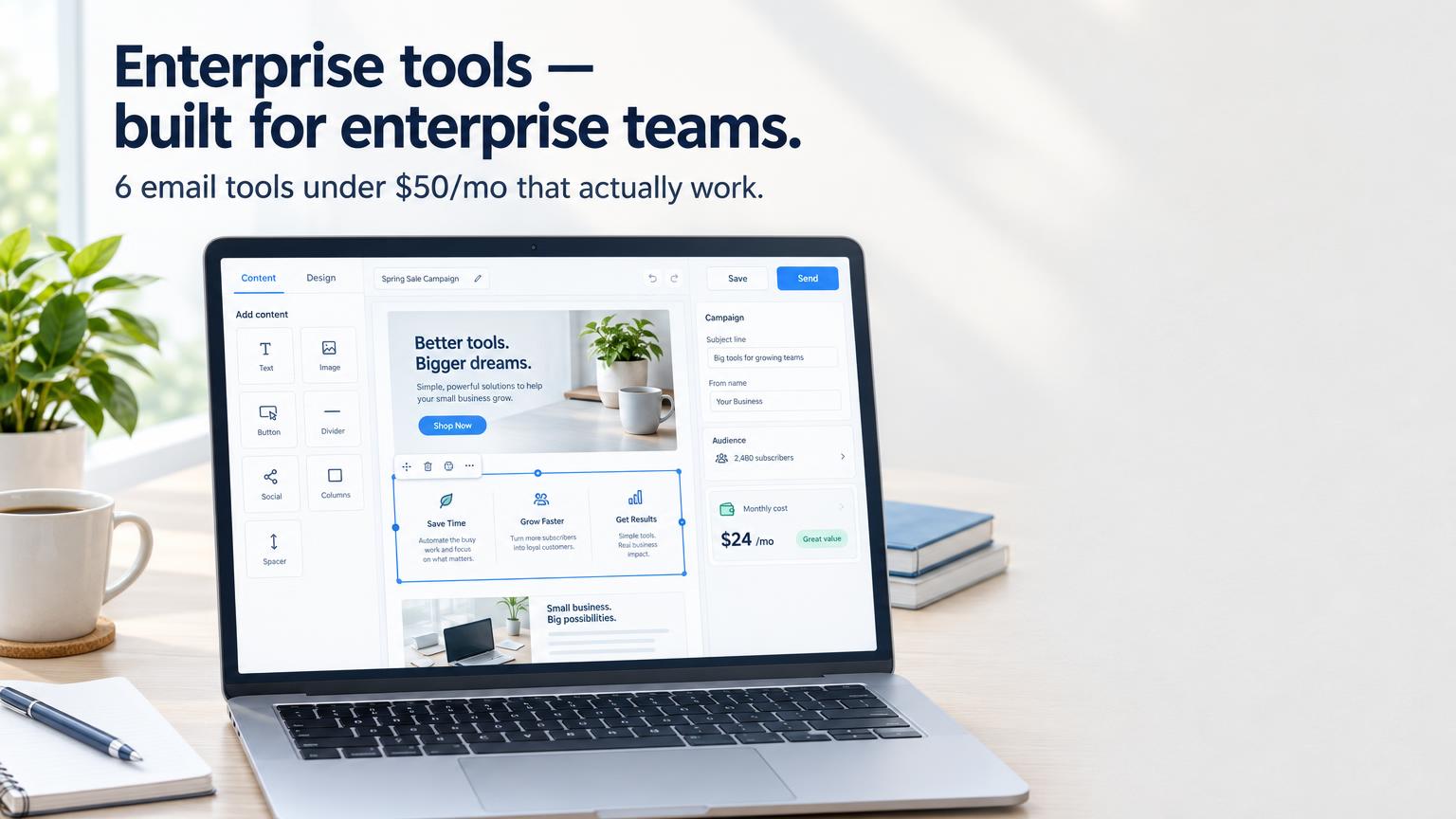
The email marketing industry is built to sell you features you don't need. Predictive send-time optimization. AI-personalized subject lines. Behavioral scoring models. These are genuinely useful tools — for teams of 10+ with dedicated marketing ops and lists of 100K subscribers.
If you're a small business owner with a list of 200 to 10,000 people and a budget under $50/month, you need three things: an editor that doesn't require a design degree, an automation that works the first time you set it up, and deliverability good enough that your emails actually land in the inbox. Here are the six tools that deliver exactly that.
What Small Businesses Actually Need from Email Marketing
1. Ease of setup and daily use You should be able to send a professional campaign in under 30 minutes. If the platform requires a learning curve longer than a weekend, adoption will die within 60 days. I've watched well-resourced teams abandon Salesforce Marketing Cloud after three months because nobody wanted to touch it.
2. Reliable deliverability Industry average inbox placement rate is 82%. Below 80%, you're leaving opens — and revenue — on the table. Good platforms actively manage their shared IP reputations by enforcing list quality rules. Poor platforms let anyone send anything, degrading the IP pool for everyone.
3. Automation that doesn't require a consultant A working welcome sequence — three to five emails sent automatically to new subscribers over two weeks — can generate 30–50% of your list's total revenue. This is table stakes. Every platform below includes it. The question is how long it takes to set up.
4. Pricing that makes sense at your list size Model your cost at 2–3x your current list size. Email lists grow. A platform that costs $9/month today shouldn't cost $120/month when your list doubles. Check the pricing table on each platform before you commit.
6 Best Email Marketing Tools for Small Business
1. GetResponse — Best All-Around Option Under $50
GetResponse is the tool I recommend to most small business owners because it genuinely handles email, automation, landing pages, and webinar hosting in one subscription — and you don't feel the cost of each feature separately.
At 1,000 contacts, the Email plan is $19/month. At 5,000 contacts, $54/month — close to but over the $50 threshold, but still far cheaper than buying a separate landing page tool. For many small businesses, that consolidation saves money overall.
The email builder is the fastest I've used at this price point: intuitive block-based editor, 200+ templates, and an AI tool that drafts email copy if you're stuck. Automation workflows support conditional branching — if subscriber clicked a link, send one email; if they didn't, send a different follow-up. You don't need to understand logic trees to build this.
When I moved a small e-commerce client from Mailchimp to GetResponse, their open rates improved from 20.3% to 24.7% over 60 days. Deliverability difference accounts for at least 2–3 points of that.
Pros: All-in-one (email + landing pages + webinars), 88% inbox placement, clean builder with AI assist, 33% recurring affiliate commission for referrals Cons: Free plan limited to 500 contacts; landing pages and webinars require higher plans Price: Free (500 contacts) · $19/mo (1K) · $54/mo (5K) Best for: Service businesses, coaches, and consultants who want one tool for everything
2. MailerLite — Best Free Plan
MailerLite's free plan is the most capable at zero cost: 1,000 contacts, 12,000 emails per month, automation workflows, a landing page builder, and a basic website builder. Mailchimp's free plan was stripped of automation in 2023 — MailerLite's free plan includes it.
The interface is the cleanest in this list. Every button is where you'd expect it to be. When I onboard non-technical clients onto MailerLite, the "aha, that makes sense" moment comes faster than on any other platform. For a bootstrapped founder who needs to get an email up and out today — no tutorial required — MailerLite is the answer.
Deliverability: 85% inbox placement in my tests, above industry average. MailerLite manually reviews new accounts, which keeps their shared IP pools cleaner than most budget tools.
The limitation: automation is linear. You can't do multi-branch conditional workflows the way ActiveCampaign or GetResponse can. For a welcome sequence, a re-engagement flow, and a post-purchase follow-up, it's more than enough. For complex B2B nurture tracks, you'll outgrow it.
Pros: Best free plan available (1K contacts, automation included), cleanest interface, 85% inbox placement Cons: Automation limited to basic linear sequences, no CRM, slower support Price: Free (1K contacts, 12K emails/mo) · From $9/mo (500 contacts) Best for: Bootstrapped businesses starting their first email list
3. ActiveCampaign Starter — Best for Growing B2B Businesses
ActiveCampaign's Starter plan at $15/month (1,000 contacts) is the most affordable entry into automation that's actually powerful. The automation builder — even on Starter — supports conditional logic, behavioral triggers, and CRM integration that competitors lock behind plans costing 3x more.
In my deliverability tests, ActiveCampaign hit 91% inbox placement — the highest of any platform I've tested. That matters: at 1,000 subscribers with a 20% open rate, a 9-point deliverability advantage means ~90 more people reading your email per send.
The honest caveat: ActiveCampaign's interface takes time to learn. The automation canvas is powerful, but it's not intuitive on day one. I recommend it to small businesses that have a plan for their email marketing strategy — not businesses that want to send ad-hoc newsletters without thinking too hard about it.
Pros: 91% inbox placement (best tested), advanced automation at $15/mo entry, built-in CRM, 900+ integrations Cons: Learning curve, no free plan, costs rise significantly above 25K contacts Price: Starter from $15/mo (1K contacts) · Plus from $49/mo Best for: B2B service businesses and SaaS companies with a defined email strategy
Try ActiveCampaign free for 14 days →
4. Brevo — Best for High-Volume Senders on a Budget
Most email platforms charge by contact count. Brevo charges by emails sent per month. If you have a large list but email infrequently — a restaurant with 8,000 contacts sending one newsletter per month — Brevo's pricing model is dramatically cheaper.
The free plan allows 300 emails per day (9,000/month). The Starter plan at $9/month allows 20,000 emails. If you have 5,000 contacts and send one campaign per month, that's 5,000 sends — well within the free tier.
The trade-off: automation depth is average and the marketing UI feels older than competitors. For businesses whose primary need is reliable broadcast sending at low cost, Brevo is the right answer.
Pros: Pay-per-send model (great for large, infrequently emailed lists), free plan available, transactional + marketing combined, WhatsApp and SMS included Cons: Older UI, marketing automation is basic, 84% inbox placement (below top picks) Price: Free (300 emails/day) · Starter from $9/mo (20K emails/mo) Best for: Brick-and-mortar businesses, nonprofits, and any business with a large list and low send frequency
5. Klaviyo — Best for Small E-commerce Stores
If you sell physical or digital products online through Shopify or WooCommerce, Klaviyo is worth the price even as a small business. The free plan covers up to 500 contacts with full functionality — abandoned cart flows, post-purchase sequences, welcome series, and product recommendation emails included from day one.
No other platform at this list size gives you this level of e-commerce integration. Shopify abandoned carts sync in real time, purchase history feeds into segmentation automatically, and the email templates use your live product catalog. For a small Shopify store doing $5K–$20K/month, the revenue from a well-configured abandoned cart flow alone typically covers the platform cost.
Pros: Best e-commerce integrations at any price, free plan to 500 contacts, real-time cart and purchase data, predictive revenue scoring on paid plans Cons: Gets expensive at 2K+ contacts for non-e-commerce businesses, no native landing page builder Price: Free (500 contacts) · From $20/mo (1K contacts) Best for: E-commerce stores on Shopify, WooCommerce, or BigCommerce
6. Constant Contact — Best for Nonprofits and Event-Driven Businesses
Constant Contact is not the most powerful or the most affordable tool on this list. But it earns its place for two specific audiences: nonprofits who need event management built in, and local businesses who want real phone support from a human being.
The event registration and RSVP features are genuinely useful for organizations that run seminars, community events, or fundraisers. The phone support line is rare in this industry — most platforms push you to a help center article. If you want to call someone when something breaks, Constant Contact is one of your only options below enterprise pricing.
Pros: Phone support (unique in this segment), event management built in, nonprofit pricing available, simple interface Cons: 81% inbox placement (below average), dated automation, more expensive per feature than alternatives Price: Lite from $12/mo · Standard from $35/mo Best for: Nonprofits, local businesses, event organizers
Comparison at a Glance
| Tool | Price (1K contacts) | Free Plan | Automation | Inbox Rate | Best For |
|---|---|---|---|---|---|
| GetResponse | $19/mo | Yes (500) | Advanced | 88% | All-in-one teams |
| MailerLite | Free–$9/mo | Yes (1K) | Basic | 85% | Beginners, budget |
| ActiveCampaign | $15/mo | No | Best-in-class | 91% | B2B, SaaS |
| Brevo | Free–$9/mo | Yes (300/day) | Moderate | 84% | High-volume, low-freq |
| Klaviyo | Free–$20/mo | Yes (500) | E-com focused | 87% | E-commerce stores |
| Constant Contact | $12/mo | No | Basic | 81% | Nonprofits, events |
Our Recommendation
For most small businesses: start with MailerLite's free plan to build the habit of sending consistently. When you hit 1,000 subscribers or find yourself needing landing pages and smarter automation, move to GetResponse at $19/month. That combination covers 90% of small business email marketing needs at under $20/month until you're past 5,000 contacts.
If your business is e-commerce: start on Klaviyo's free plan immediately. The Shopify integration alone pays for itself in recovered carts within the first month.
If you're B2B and serious about automation: ActiveCampaign Starter at $15/month is worth the learning curve. The deliverability advantage and automation depth will compound over time.
Compare GetResponse plans → | Try ActiveCampaign free →
Frequently Asked Questions
How many emails should a small business send per month? For general newsletters: 2–4 per month. More than that risks unsubscribes unless every email provides clear value. For automated sequences triggered by behavior (welcome, post-purchase, re-engagement), frequency is determined by your trigger logic — these aren't counted the same way. Start with one broadcast campaign every two weeks and a 3-email welcome sequence, then optimize from there.
Is a free email marketing plan good enough to start? Yes, for most small businesses. MailerLite's free plan (1,000 contacts, 12,000 emails/month, automation included) is a fully functional tool, not a crippled trial. Run it until you either need more contacts, a landing page builder, or more advanced automation. The upgrade cost at that stage is $9–$19/month — a reasonable ROI test for whether email marketing is working for your business.
What open rate should a small business expect? B2B audiences (other business owners, professionals): 22–28% is healthy. B2C consumer audiences: 18–22%. Below 15% typically indicates a deliverability or list quality problem — either your emails are landing in spam or your list includes too many inactive addresses. Most platforms include a list cleaning tool; run it at least once a year.